This is a new area for Oligometrics, born out of a need to create from scratch materials which make it possible to manipulate proteins in the lab. Currently available products suffer from the problem almost all commercial products suffer from, namely, they are made from either unavailable recipes or by using proprietary methods, and so it is not possible to tell exactly what they are made of or to understand why one batch might work in a given application and another batch might not work.
Polymerization, especially photopolymerization, is exceptionally easy to perform. If a liquid acrylate pre-polymer is mixed with a photoinitiator and allowed to fill the space between two glass plates spaced apart by about 0.1 mm, irradiation with an ordinary UV black light for 15m results in a solidified apparatus which can be separated by soaking in water or ethanol. Then, the glass plates are recovered for reuse, and the liquid has a nice membrane floating around in it which has as its large dimensions the same dimensions of the glass plates and a thickness of about 0.1 mm. The amazing thing is how versatile this method is, because any substance which is soluble in the pre-polymer can be locked into the polymerized membrane. Or, if the membrane is a hydrogel, any substance which is water soluble (and is not an acrylate) will wash out of the membrane, leaving empty space where is was first locked in during the polymerization. These spaces, or pores, impart useful properties to the hydrogel, such as an enhanced ability to absorb water.
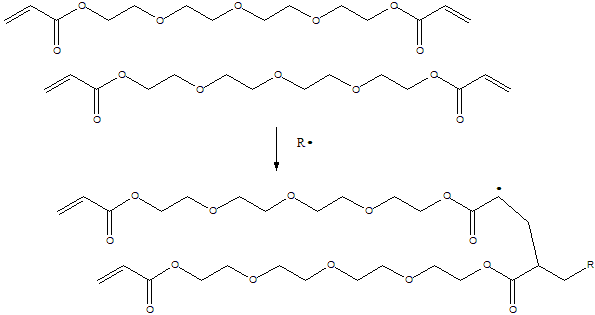
The image at right shows the first step in the polymerization of PEGDA. A photo-initiator is used to generate the radical R which adds to a double bond, generating another radical which forms a C-C bond to the next monomer. The reaction is shown stopped with a radical on the second monomer, but this radical will go on to react making more radicals until eventually all the double bonds have reacted. Since pure PEGDA is a crosslinker (has two acrylates attached to it), the resulting polymer is insoluble and highly crosslinked.
____________________________________________
_____________________________________________
We have found that if PEGDA is diluted with a polyethylene glycol solvent prior to polymerization, it is easier to work with the fiims and they absorb large amounts of water. This process results in highly crosslinked films with hydrophobic pores after the water soluble glycol has been leached out, ideal for interactions between the polymer and water soluble proteins.
The hope is to eventually incorporate metals in the PEGDA films which will behave much like the metals in IMAC resins. The hard part is to immobilize them. This can be accomplished in two ways.
- Add a transition metal salt to the prepolymer. This is possible because of the very high solvent power of PEGDA, where the polyethylene groups interact strongly with metal nitrates.
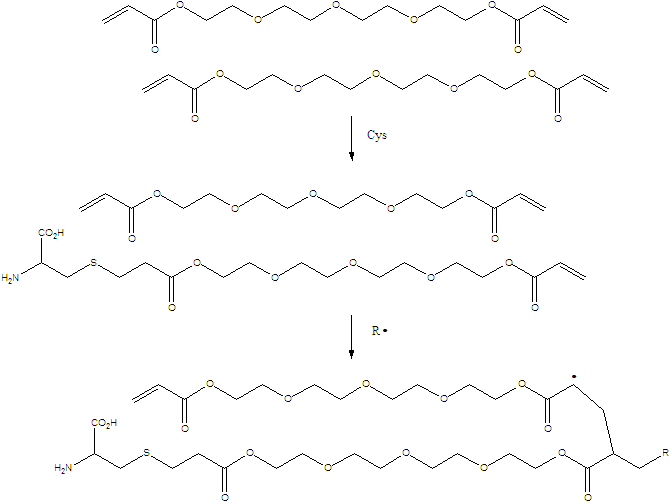
- Incorporate an organic ligand into the film, either before or after polymerization. If it is before, the ligand must be able to copolymerize with acrylate groups, so it must have double bonds. If it is after, a strategy such as shown at right can be used, where a strong sulfur nucleophile reacts with leftover acrylate groups. In either case, the ligand must bind metals with high affinity, such as NTA.
Both approaches
are being pursued since the polymerization of PEGDA
seems to trap cobalt ions in cages in the first case, and
PEGDA films react with cysteine to give covalent
modifications at leftover bouble bonds in the second.